This a short devotion I wrote for a local church on the subject of Mary’s promise for Jesus’ life…
When we are called to God’s service, we have an expectation of how it will look and pan out. In Luke 1, the angel gives Mary a message that her son “will be great and will be called the Son of the Most High”. How shocked she must have been when she laid her newborn son in a cattle trough! God’s message to Mary was of greater things to come, a promise to hold onto when life seemed to be going in the opposite way.
Often we have an idea of how God wants us to serve him, but the reality doesn’t always match our expectations. We become disillusioned and thoughts of quitting roam our minds. It is in these seasons that God reminds us to hold on to the vision he has given us; food for the journey for when the road seems long. God’s plans look different to our own, but we can be sure that his promises always come to pass. If you are following God’s dream for your life, the Lord will see you through the desert to the promised land. As for Mary, her baby may have had a rocky start, but he went on to a glorious ending.
A few weeks ago I went to see the Amazing Grace film about the recording of the famous Aretha Franklin gospel album. Filmed and recorded in 1972, it is the only gospel recording that Aretha made after becoming a Grammy Award winner. Granted there are recordings of her leading worship as a teenager at her father’s Baptist church, but this is the only album she made with a Christian emphasis in her professional singing career. As a star she often talked her of faith in God and how it underpinned her life, let alone her career.
One of the issues that has distressed me over the years, is the constant criticism from some Christians who declare that she turned her back on God and the church in order to follow a musical path. My own experience is that the church often tries to keep musicians and artists within its walls should they try and do something that would lead them astray and destroy the reputation of the faith. Yet musicians and artists are visionaries who hear and see what God has placed within them. Aretha’s journey wasn’t so much about walking out of the church, but more about being sent by God into an industry that needed him. She was often described as shy and quiet, yet when she opened her mouth the passion and conviction poured out through her singing, a talent and drive that come from the strength of something much greater than her.
This album celebrates Aretha’s personal testimony of her journey through a difficult life. A single mother by the time she was 13 years old, divorces, an abusive home life and the back drop of slavery and the civil rights movement all led her into a deeper relationship with God. However, while some Christians decry her fame and status as ungodly, there’s also the possibility that God put her into that position so that he could use her to help others. Aretha’s Amazing Grace album is the best selling gospel album of all time, beating her gospel rivals. Not bad for someone who made their name as a soul singer.
What is also interesting about this album is the rawness of the occasion compared to other recordings of that era. It is reported that Aretha wanted to capture live worship as she knew it in her own church and present it to a wider audience who had no church background. The album allows us to hear Christians worshipping openly in a Baptist church in Los Angeles with a small congregation of both believers and non-believers. This album wasn’t about creating a studio atmosphere with great musical prowess, but about opening a window on praise and adoration of the Lord for those who had never experienced it. Aretha displays a dedication to take the church and God’s love out to the world rather than to wait for people broach the church door tentatively. As Christians, we are asked to take the message of God to our mission field, Aretha just does on a much grander scale using her status and platform to spread the gospel of Jesus. What is notable is that on the second night of the recording, the congregation doubled in size as word spread about the “free” Aretha concert. Even Mick Jagger makes an appearance in the crowd.
However, it isn’t just this album which makes Aretha’s legacy so unique. She was known for singing about women’s rights and independence, performing strong and powerful lyrics that women across the world identified with. Many of her songs became anthems for change and breakthrough; we’re all familiar with Respect and Sisters Are Doin’ It For Themselves and the powerful message that pervades these performances.
While the some factions of the church may be mourning the loss of musicians who follow a different path, others are valuing the mission work that they are doing. The music business is one of the most uncharted industries when it comes to Christian missionaries. Aretha’s entry into this world meant the gospel was spread further. I’m not suggesting that all church musicians and artists should up and leave, more that the church should recognise their call and prophethood into an area that needs light and hope. Artists and musicians are called to carry the very heart of God into a world that needs help and this includes the entertainment industries.
I know the church feels the need to protect creatives from sex, drugs and rock n roll, however in doing so, sometimes it stops people from fully fulfilling their calling. There needs to be an element of trust that God knows what he is doing. I’ve often been criticised for writing secular songs, however I do believe that this is what God has called me to do. One wonders if the church lets down artists, such as Aretha Franklin, by not supporting them more. Perhaps less stars would go off the rails if the church walked with them through their musical careers. I think what we can glean from Aretha’s life is that God used her powerfully and that her music touches the lives listeners around the world. Music is more than worship, some songs heal by the fact that we identify with the pain, others uplift when we feel down, or build community when we all sing together. Music has more than one role in life.
Perhaps it is time for the church to let more creative people go and do what they do best and reap the harvest of music and art that comes from it. We’re not walking out of church, but walking into what God has called us to do.
The journey to becoming you is a lifetime process, and the same can be said about becoming a musician or artist. It’s an amble through trial and error, followed by readjustment and acceptance. If you can navigate through the pitfalls well and learn from them, then you can become more resilient and focused on what you are supposed to be doing. You have to learn not be to discouraged at each hurdle but to pick up the pieces and get going with your vision. And there’s the crux of being an artist… VISION. It gives us a reason to create, a message to deliver and a community to focus on.
Very few creatives reach the pinnacle of their career with their first project; if they do reach the heady heights quickly, the harder they fall. If you gain access to a public platform, you need to be prepared to have a good message for your audience. You also need to have the character to bear the weight of the responsibility of speaking into situations that need wisdom, to give hope and not despair, to be positive when others are negative. Character develops under pressure, through perseverance, by overcoming obstacles and be willing to admit that we aren’t always right. If your character is weak, you will struggle to carry greatness and influence a world that is easily swayed. People are looking for a consistent, strong message that brings light into darkness; that type of maturity doesn’t develop overnight, it is born out of adversity and longevity.
Often it’s in the seasons of “no” and “not yet” that we find out who we are. Like a seed planted under the soil, we grow in the dark seasons of our lives. The disappointments become fertiliser for our creative outlook. Even though the soil buries us, fresh green shoots spring up and bloom in the sunlight: something new is born. The tender shoots push the dirt away and reach out of the light. Those difficult seasons may seem to have no purpose but ultimately our personhood gets chiseled away by our experiences, and walking through fire helps refine and define our character. We are more than the sum of our experiences though, we are divinely created with a unique spirit, mind and purpose. We have a reason to be and a reason to do.
Being an artist requires the gift of prophecy, to see what could be and call it into being. Most of us have been inspired by a song, book, or painting at some point in our lives, something that gives us vision and inspires us to be more, to push the boundaries. Each artist has spent time thinking about how to convey something new to their audience, using the opportunity to impart wisdom and infuse hope as part of their legacy to the world. It can be a lonely role, to move forward with a vision that others don’t yet see. It requires tenacity, perseverance and a willingness to sacrifice comforts to make the vision come to pass. You have to grow the vision and then give birth to it.
So be encouraged wherever you are on your artistic journey, that the highs and lows are all part of the process of becoming who you are. You are becoming the artist that you want to be. A diversion doesn’t mean that you won’t reach your destination, it means you have something to learn along the way. The journey is often more important than the destination. Don’t be impressed with everything you see and hear, but work on being unique and find your own voice. No-one can be who you are. Rejoice in your uniqueness and work on your weaknesses. Surround yourself with people who support you but don’t pander you. Find your message and be the voice crying out in the wilderness. Speak change into a dying world and watch as your art makes a difference: a difference that only you can make.
Enjoyed this blog? Join my mailing list here and leave me a tip here.
Sometimes God likes to remind us how powerful He is. We think that we are too far gone, and that we have missed His plan for our lives. The situation seems impossible and we believe that nothing can change. Sometimes the vision He has given us for us lives seems so outlandish that we believe that it can never happen. We’re in the wrong place, doing the wrong thing, we don’t know anyone who has the contacts to help us. Our perception of God becomes limited to what we can see.
And that’s when God likes to remind us that He hasn’t forgot us, that He can do anything and bring the most unlikely of people together. On Saturday night, the doorbell rang and on the other side of the door was the much expected Tesco delivery man. What wasn’t expected, was the conversation that ensued whilst he unpacked my food order. After apologising for being half an hour early, and me saying “oh that’s fine, I needed a break from editing a song”, we discovered that we both had something in common: MUSIC. Turns out that he’s a sound engineer and mixes and masters a lot of projects for the BBC and local radio. Somewhat downcast, he then said “I expect you’re wondering why I’m working for Tesco”, I replied, “not really, lots of people in the music industry have several jobs. Helps to pay the bills”. And at the point, he relaxed and his story came tumbling out…
Turns out he needed some encouragement and to hear that it’s ok to have multiple, different streams of income. He needed someone to say that they understood how hard the music industry can be and that he’s not alone. We talked about the seasonal nature of life and that low points can often to be a blessing as they lead us to make changes that create new seasons and creativity in our lives. I was rather surprised to be having this conversation on my doorstep; I hadn’t thought I’d be discussing this in my slippers whilst checking if my favourite crisps had been delivered but evidently it was a divine appointment which was beneficial for both of us.
What God was reminding me, is that He isn’t limited by our location or condition. He can bring two people together and make His will happen. Divine connections can happen in the strangest of places, and when we least expect it. He doesn’t need us to try and engineer these meetings, He’s got it all under control. Some of these encounters are short lived and serve to encourage us, while others have a lasting effect and are to bring us into opportunities and seasons of life. The important thing is to be prepared for the unexpected, we never know when God will want us to help someone or to be available to make something happen. Whilst He doesn’t need our help, He loves to partner with us so that we can see how powerful and great He is. It’s often in the smallest of details that we realise that God loves us and has a plan for our lives. Often what keeps life exciting, is the encounters that makes us say “I wasn’t expecting that…”
I’ve waited a long time to write this blog; seven years to be precise! Seven long years. We all have a dreams of things that we would like to do and sometimes we get the opportunity to do them. The saddest thing is when one of those dreams is struggling and no matter what we do, it doesn’t survive and eventually dies. It can be a game changer; it affects your perspective on life and can make you retreat from other opportunities for fear of getting hurt.
In 2012, I was offered the opportunity to perform my songs with a jazz orchestra. It was a dream gig, I’d waited all my life for it and I was going to make it happen! The early discussions went well, and I was ever hopeful that the concert would take place within six months. However, over time the project began to disappear, no matter what I did I couldn’t make it work. The dream concert was long gone, and my music career seemed to be dead. I asked God to put it right and bring the project to fruition, but nothing happened. Things went from bad to worse, my business collapsed, my marriage failed and my living arrangements were insecure again. I never knew that life could go so low so fast. It all changed in an instant.
Last year, my colleague and long standing friend, Rachael Forsyth, contacted me and asked if she could pitch the project to an orchestra again and also do the jazz arrangements of my songs. My initial reaction was that it wasn’t sure that I wanted to go through all the disappointment again, however, that thought of “if I don’t try, I’ll never know” crept in and I decided to be brave and give it a go. Over a period of six months we plodded through arrangements and emails, and we wondered if it would ever come together. At one point it actually looked as though the whole thing would fall apart again and Rachael and I prepared ourselves that it might not happen.
But that’s not the way God works. He specialises in bringing dead things back to life. After seven years of waiting, wondering, praying and hoping, I will be performing with the English Jazz Orchestra on Thursday 14 March. I can’t believe it’s taken this long, but those prayers that I prayed seven years ago are finally being answered. Just because something looks dead doesn’t mean that it is. Sometimes God waits so things are better, the timing is right and our character has developed enough for us to deal with it. Sometimes he removes things that are in the way or that will destroy the dream, so that when the dream buds, it can flourish and grow without being choked. Although this seems strange, all those things happened for my good. That part of my life died so that better, greater things could come. Sometimes God allows these things to happen so that he can realign us with his plan for our lives and also his timing (which is never our timing!).
In another strange twist of events, I received an email today saying that a song I sent to a DJ three years ago, is now being played on his podcast this month. I’d actually forgotten that I sent it off to the radio show! It’s like the song was waiting for right moment.
So I hope you can join me for this amazing evening St Lukes Church in Enfield with the English Jazz Orchestra (ENJO)! Tickets are available here
We live in a society that expects everything instantly. Everything is on demand: TV, films, music, food delivery within the hour, 24 hour shopping. Nothing is out of reach. You want it, you got it. This translates into several other areas of our lives too – we expect to have a good life from a young age. At 18, you should know what you want to do with your life and have the school grades to open doors. By 30, you should have a career, financial security. And so it goes on: marriage, mortgage, kids and life sown up by 40… Modern life wants us to have everything when we’re young; prosperity is a sign that we’ve “made it” and have “success”.
However, what modern life doesn’t account for, is that we might not be ready or mature enough to receive the things we want. Character and strength take years to develop, and not necessarily through times of ease and joy. Perseverance and wisdom come through trials and times when our backs are up against the wall. If we don’t have the right character, there’s no way we can carry the new in depth experiences or the rewards that we have worked for. We have to learn to steward these things, and steward them well. This means accepting that there is more to life than us. Others may benefit from our experiences and blessings. It’s good to share the joy and rewards as this spreads encouragement and hope.
If we have everything now, there’s nothing to look forward to later. Life events need to be measured out at a life long pace. It’s not that these events will be equally spaced out, but divinely placed for the right time. Often we have an inkling or desire that is an indication of our destiny, a foretaste of what’s to come that keeps us on track and moving in the right direction. The world wants us to have the mentality of the child in a sweet shop, while God wants us to look to him and trust that he will bring good things at the right time.
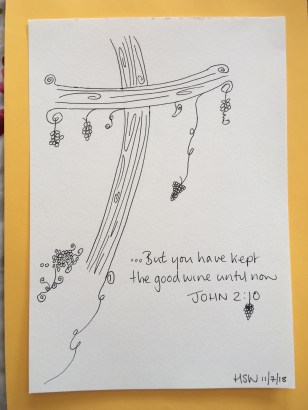
A few weeks ago, I was sketching some ideas for a project and when I started to draw the featured picture. I knew immediately that it was for one of my friends who supports my work, so I sent it to her the next day. She was amazed because she had been discussing the idea of God “saving the best till last” the very same day. In John 2, the wedding party are expecting to have the best wine first but when they run out of wine, Jesus surprises them by turning water into the finest quality wine. He uses a dead end situation to perform a miracle, and to create the miracle, he uses the most mundane thing, water. If he can do that at a joyful event such as a wedding, he will do the same for us in the most dire of situations too. He can take our “nothing” and turn it into a miracle.
It’s OK to take our time and wait for good things rather than mediocre things. We often settle for what seems good but actually isn’t God’s best for us. Long term these things can harm us, or stunt our growth and relationship with him. All that glitters is not gold, and we can miss out on some exciting things by taking matters into our own hands.Sometimes things end suddenly or don’t end well and we’re shocked at the change of path. A bad season isn’t forever, everything has an expiration date and life can turn around for the better. Patience and discernment lead to good things, character strength and an exciting future. God is always saving the best till last.
Illustration: Save The Best Till Last by Helen Sanderson-White (Copyright 2018 Helen Sanderson-White. Do not reproduce without permission).
Every time New Year’s Eve rolls around, I have two little rituals. Firstly, to have the biggest clear out known to man, which everyone in my house fears as I can be quite ruthless! It’s therapeutic to clear out the old in readiness to welcome the new. And secondly, that I exchange Bible verses and words with friends and family for the coming year.
Four years ago, a friend sent me the phrase “Do not be afraid”. On receiving this, I was non-plussed but rather excited about what might happen. Over the following week, I received the same phrase and some accompanying Bible verses from other people, one of which I didn’t know very well, so I was pretty sure that God was trying to say something to me. What I didn’t know at the time was that God was taking me on a journey, some of which I had not expected.
Over the next four years, God reminded me of words and dreams he had given me twenty years ago. A lot of these I had long abandoned as they didn’t seem to materialise and I presumed that I had got it wrong or that God had changed his mind. Nevertheless, throughout 2014 God kept telling me that he meant business with his promises and that he is in the process of bringing them about. This turned out to be an essential period of encouraging and building me up for what was come. However, sometimes for God’s plan to prevail we must be realigned with his plan…
Time rolled on and life became difficult and not what I was expecting. A drunk driver smashed into the front of my house and we had to move out in the middle of the night; we landed up moving house four times in fourteen months. Due to the endless moves and other issues, my business collapsed and on top of that a joint business venture ended when my business partner walked out. And the final straw came when my fifteen year marriage ended quite dramatically. It was a rock bottom time; I was abandoned, abused, ridiculed, homeless, and I left my marriage with two my children and £85 in my pocket. I didn’t know what would become of me. Looking back now, I can see that God was having a clear out out in my life so that he could bring me into line with his plans.
What sustained me through this period were the promises that God made me and his encouragement to keep going. Most days I just wanted to lay down and die, except you can’t really do that when you’ve got two children! You have have to keep going and as time has gone on life has improved. I’m still waiting on God to come good on some of those promises. One in particular has already come to fruition and came quite suddenly and unexpectedly. Sometimes to get to where God wants us to be, we have to allow everything to die, so that he can do a new thing. I’m looking forward to God doing new things and bringing about what he promised. Guessing how he is going to do it just makes it all the more exciting. Sometimes it’s good that we can’t see everything in advance. Through all of this, I had plenty to be afraid about: a court case, finding a job, relocating yet again, moving my children to their fourth school. But in the end everything has eventually fallen into place. And now I walk on into the future and wait for God to do the things he promised all those years ago… DO NOT BE AFRAID.
A few weeks ago I did my first concert after a long break. It was nine months since my previous gig and it felt strange to be preparing to perform again. Although, having sung in public since I was three years old, it was like greeting an old friend again. Even life punctuated by music must include periods of rest if the sound is to be of quality. Preparing for this concert was a real journey, I went through folder after folder of material looking for songs to perform. I started with rather a small list but by the end of the week, I had far more material than I had bargained for.
One of the songs that was really popular at the concert was Do You Seek An Answer from At Second Glance. It raised quite a reaction from the audience that was unanimous: life brings us more questions than answers. I wrote that song in 2008 in a period of my life that brought many questions as I watched both friends, family and myself go through difficult times. Prayers that were either unanswered or answered in a way that wasn’t expected, hopes dashed and resurrected, and situations that seemed unfair or unpredictable. Experience tells me that God allows us to walk through these seasons of unanswered questions to help our faith grow. He is far more interested in a relationship with us, than answering a shopping list of needs. It’s not that he doesn’t want to meet those needs (and in some way he always does), it’s that he wants us to get to know him and for our character to grow to be more like him. It’s the waiting with expectancy, the dwelling on his word and the realisation that he wants good things for us that brings us in line with his character and will. If we wait for God and watch him, we experience peace, hope, strength and God’s vision for the future. When we are anxious, we’re exhibiting the symptoms of mistrust and attempting to carry the situation in our own hands.
Where there’s hope, there’s peace…
A few days ago I was watching my son walk down the road to school. His gait always entertains me, it’s filled with joy and fun as he gallops off in every direction. He’s at that age where he has no inhibitions. On this particular day he was enamoured with the blossom: “look mum, blossom snow”. He danced under a tree that was shedding is blossom and in that moment, I realised why I love his little gallop so much: it is full of hope and expectancy. There he was, dancing in the petals enjoying spring. Maybe that’s how we should be during these times of questions and no answers, expectant and full of hope. Happy to accept that God will move when he is ready, holding onto the peace that only he can give. We’re not always meant to know the answers, but to trust that everything will come good in the end.
 Often we have an idea of how God wants us to serve him, but the reality doesn’t always match our expectations. We become disillusioned and thoughts of quitting roam our minds. It is in these seasons that God reminds us to hold on to the vision he has given us; food for the journey for when the road seems long. God’s plans look different to our own, but we can be sure that his promises always come to pass. If you are following God’s dream for your life, the Lord will see you through the desert to the promised land. As for Mary, her baby may have had a rocky start, but he went on to a glorious ending.
 The journey to becoming you is a lifetime process, and the same can be said about becoming a musician or artist. It’s an amble through trial and error, followed by readjustment and acceptance. If you can navigate through the pitfalls well and learn from them, then you can become more resilient and focused on what you are supposed to be doing. You have to learn not be to discouraged at each hurdle but to pick up the pieces and get going with your vision. And there’s the crux of being an artist… VISION. It gives us a reason to create, a message to deliver and a community to focus on.
 And that’s when God likes to remind us that He hasn’t forgot us, that He can do anything and bring the most unlikely of people together. On Saturday night, the doorbell rang and on the other side of the door was the much expected Tesco delivery man. What wasn’t expected, was the conversation that ensued whilst he unpacked my food order. After apologising for being half an hour early, and me saying “oh that’s fine, I needed a break from editing a song”, we discovered that we both had something in common: MUSIC. Turns out that he’s a sound engineer and mixes and masters a lot of projects for the BBC and local radio. Somewhat downcast, he then said “I expect you’re wondering why I’m working for Tesco”, I replied, “not really, lots of people in the music industry have several jobs. Helps to pay the bills”. And at the point, he relaxed and his story came tumbling out…
 I’ve waited a long time to write this blog; seven years to be precise! Seven long years. We all have a dreams of things that we would like to do and sometimes we get the opportunity to do them. The saddest thing is when one of those dreams is struggling and no matter what we do, it doesn’t survive and eventually dies. It can be a game changer; it affects your perspective on life and can make you retreat from other opportunities for fear of getting hurt.
 We live in a society that expects everything instantly. Everything is on demand: TV, films, music, food delivery within the hour, 24 hour shopping. Nothing is out of reach. You want it, you got it. This translates into several other areas of our lives too – we expect to have a good life from a young age. At 18, you should know what you want to do with your life and have the school grades to open doors. By 30, you should have a career, financial security. And so it goes on: marriage, mortgage, kids and life sown up by 40… Modern life wants us to have everything when we’re young; prosperity is a sign that we’ve “made it” and have “success”.


 ere’s hope, there’s peace…
 Helen Sanderson White