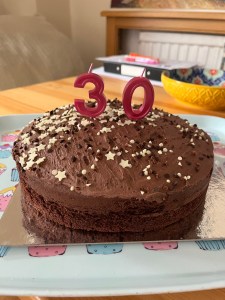
Thank you to everyone who has helped me celebrate 30 years in music education this weekend! It’s been lovely to have so many people pass through the house for a chat.

I started teaching in 1995 in my year out before I went to university. My first job was teaching music in two primary schools in Torquay. I went on to teach singing, piano, music theory and songwriting to children and adults at FE colleges (Morley College, London and Kensington and Chelsea College), Oxford Youth Choir, art centres, theatre schools, holiday clubs, churches and private practice. I’ve taught in Devon, London, Buckinghamshire, Oxfordshire and Hertfordshire.

After 30 years, I’d say that my specialisms are pop music (no surprises there, after having a successful pop career myself!), and teaching and mentoring students who are broken by the education system. Schools operate on a “one size fits all” system, which tragically fits very few people. I am proud to offer a teaching service that is tailored to individual needs and desires, and I have the 100% success rate to support that this approach works.

My students have taken grade exams, taken GCSEs and A levels, gone to university or music colleges, started bands, gone on tour, entered competitions, written and recorded their own albums, joined choirs, become music therapists, and starred in shows locally and in the West End and also gone on to be music teachers. And many adult students have made a started a new or second career in music…

Who knows whether I will be teaching in another 30 years… I will be 78 then! However, I believe in music education and will continue to promote the need for people of all ages to access this easily. Keep making music people!

Helen Sanderson White BA (Hons) BA (Hons) LRSL

Twenty years ago, I lived in London and worked teaching music with churches and further education colleges. Most of my work was with underprivileged young people living in areas of deprivation and poverty. Wealthy, salubrious neighbourhoods bordered these city areas, yet for most of the teens and young adults I worked with, this lifestyle was out of reach. They had become accustomed to accepting that their career path would be crime. Shootings and violent attacks in the area happened with alarming regularity, gangs and drugs became an easy option for a living. 

As I reflected on this culture, I wondered how I would express the Gospel to young people who had never heard of Jesus. How would I explain the cross and resurrection to them? As I discussed this with my church youth group, the breakthrough moment came when one of the young people said that the highest honour in gang culture was to take a bullet for a friend. That was the way in for me to explain to an unchurched community what Jesus did for us through his death on the cross and the resurrection: he took the bullet for us, so that we can live with him forever.  

Sometimes we need to understand the culture we are living in so that we can explain the Gospel using a vernacular that our community can relate to; a contemporary example that connects people with the divine. As we go about our week, perhaps we should ask ourselves, in what ways do my community need to hear about Jesus? 

At thirty years old there were words in his head 

He didn’t know where they would lead to 

The burning words, well they all signalled red 

But somehow he had to see it through 

He took the bullet for me, He took the bullet for me 

At thirty years old he took a trip out of town 

He knew he had to speak the truth 

The scholars and vagrants, they branded him a clown 

They didn’t want to see the living proof 

He took the bullet for me, He took the bullet for me

At thirty-three years they put a gun to his head 

They knew they had to end his reign 

What they didn’t know when they left him for dead 

Is that he’d come to reign again 

He took the bullet for me, He took the bullet for me

Copyright 2007 words & music by Helen Sanderson White 

If you have found this blog helpful, join the mailing list here.

Want to make a donation to my work? Please click here.

Amazon has released a new film called You Hurt My Feelings starring Julia Louis-Dreyfus and Tobias Menzies as an under-confident couple who struggle with finding fulfilment in their work. Julia’s character overhears her husband (Menzies) telling her brother-in-law that her latest book isn’t her best artistic work, and the revelation shatters her. The film details how the couple explore being honest with each other and learning to let go of their co-dependent affirmation.

Should it be a given that our closest loved ones like our work? Before I get into this topic, I want to say that there are no clear answers to this question. When God calls people together it is holy and sacrosanct. Each relationship is between those people and God. 

I meet creative people all the time who are surprised or hurt by the fact that their partner or friends and family don’t like their art. Thinking back over my relationships and previous partners, some were supportive of my creativity while others were not. Needless to say, the relationships where there was little or no support did not last. Why? Because we weren’t united in the same vision. To my cost, I learnt that we need to be running in this same direction, having the same ambition for the things of God. Without this, there will always be compromises that lead us away from God’s vision for us and the things he is asking us to do. If we’re called to serve God together, then we need to be moving in harmony together, and there needs to be unity in our God-given vision and mission in life.

If we constantly need the affirmation of other people, we are driven by our insecurities rather than our faith in God. The need for admiration and love gets in the way of why we are creating. Our focus should be on following Jesus as looking for affirmation will only lead to building our ego and not our faith. Accepting encouragement is good for our wellbeing, but an unhealthy need for validation can distract us. 

There are some positives about negative criticism: someone not liking or “getting” our work gives us the opportunity to evaluate and analyse the piece and learn from it. We can see the project from a different point of view, learn more about our audience and how to communicate with them, as well as analysing the message or media used. Our work isn’t going to be everyone’s cup of tea, and this is a good thing because a small group of strong supporters is better than a large group of apathetic followers. Negative criticism from our closest loved ones is more challenging because it is hardest to hear from those we love. However, if the message is delivered to us in love and grace, we can benefit by reflecting and learning from it. We need to distinguish the difference between an unhealthy relationship that is hindering our calling and healthy criticism which sharpens and refines our work.  

Whenever we’re offered feedback, it’s important not to be dismissive but to filter what’s relevant and what’s not helpful. Finding a mentor or trusted colleague to review our projects with is a good way to gain perspective and grow in confidence. If your partner does not like a piece of your work, it’s not the end of the world but an opportunity for discussion. Loyalty is not superior to honesty, the two should work in harmony. 

Balance is a key factor to relationship stability. You’re never going to please everyone all the time. Learning to filter and reflect on criticism can lead to greater maturity and working relationships and helps us understand more about ourselves. Maturity is accepting that others are entitled to their opinion, whilst being secure in our own viewpoint. So should my partner like my creative work? If you’re depending on the praise to boost your confidence, then no, but if you’re settled in who you are and what you do, then any praise is a bonus. My personal feeling is that it is better to surround myself with people who will support and encourage but also be honest about my work, than to be with someone who always agrees, or worse, someone who discourages and is moving in a different direction. As artists, it is important to become resilient and use criticism to better ourselves, so that we can persevere and endure in our creativity. 

If you have found this blog helpful, join the mailing list here

You’ve finished a piece of work that you have loved creating. A real passion project that has been a dream come true. You’ve given your all to making this work and now it has finished. You’ve had lots of amazing comments and feedback on your creation, and it feels good, it feels amazing. Yet underneath it all, you feel drained and slightly down. How can this be? It makes no sense; your brain tells you that you should feel amazing but secretly you feel exhausted. 

Recently, I was speaking with a friend who is experiencing the post creative blues, that space within the past project and the future project. A mixed space of joy and depression that leaves you confused by the paradox of both emotions. A space that leaves you exhausted wondering if you can do it all over again. She was mainly confused by how tired and drained she felt from giving herself to a long, demanding project. Her questions ranged from, “is this normal?” to “will I feel like creating again?”. And the answer to both those questions is yes. 

The post creative blues are real. To be realistic, you’ve just given birth to a project that you have been nurturing for a long time. You’ve taken care over every detail and carefully grown an idea from a small seed of an idea into a beautiful baby. Now that baby has been born you need to rest both your mind and body before starting again. We forget this and presume that we are capable of continually producing work, that we can always give to others, but before we can give, we must receive and replenish ourselves. You can’t pour out of an empty vessel.

We are more than artists; we are human beings. Being an artist doesn’t define who we are, it adds to who we are. Learning to care for and nurture ourselves before we create is essential for our daily living, our survival. If we look after ourselves will ultimately create better more defined work, and more importantly we will enjoy what we are creating. If we’re so tired that the joy of creating has gone, then there’s no point creating. 

Part of the creation process takes us beyond ourselves and our capabilities; we channel the divine in order to create. Those artistic eureka moments bring both ease and exhaustion as we battle with our inadequacies and rejoice as we achieve our goals. The ease and exhaustion come as the divine pushes us beyond our capabilities, and we create something far greater than we imagined. The Bible tells us that God created the world in six days and on the seventh day he rested. There’s a good lesson in this, that even the supreme creator took time out to rest. 

The other issue is the loss of purpose after a project ends; suddenly we have time on our hands and we don’t know what to do with ourselves. All the drive and passion are laid down as we step back from the projection completion. It’s in these times that we need to remind ourselves of the ebb and flow of life, there are always busy and quiet times, and they follow a natural cycle. It’s important to recognise that these seasons will pass and a time to create will come around again. You haven’t lost your purpose; you are in the process of redefining your purpose whilst you wait for the next project.

The post creative blues should remind us that we have just achieved greatness in our creativity. They are signal to remind us to rest and recuperate, and to take stock of everything that we have achieved, but also that there will be further opportunities in the future. This is just the lull before we get back up and try something new, it’s not the end. If anything, the post creative blues remind us that the best is yet to come. 

If you have enjoyed this blog, join the mailing list here

Some days starting a new creative project is really hard. Creativity can be as difficult as it is pleasing. If I’m not in the mood, distractions become attractive. My head tells me that other options are available, but my heart wants to create… 

  1. Food. Yes really, I cannot tell you how many times I’ve settled down to work and my stomach has decided that food is more important. A sandwich, crisps, a biscuit (I don’t even like biscuits!), anything to stop me doing some work.  
  1. Neighbours. Suddenly the activities of my neighbours become far more interesting than writing a song, blog or doing some artwork. Who knew that next door’s Deliveroo delivery could be so entertaining?!  
  1. The box set. I’ve seen Sex And the City 8000 times, I don’t need to see it again, yet hours on the sofa seem more attractive than getting started on a blog. Also don’t let me crack open the Ghostbusters box set… 
  1. Cleaning. Suddenly I have a desperate urge to clean everything and get on top of the housework. This is partially linked to the fact that I find it hard to be creative in a messy room. For me, a tidy room means a tidy mind. Coincidently I have no urge to clean when I’m not creating. 
  1. The phone. This is a dangerous problem. Hours can be lost doom scrolling and checking out other artists and what they are up to. It can be a door to depression, so don’t go there. Don’t look at their accounts, concentrate on what you are doing. Also, whatever you do, absolutely do not look on Amazon, it leads to stupid purchases.  
  1. Old work. Looking at unfinished projects and suddenly thinking that they are more important than the piece I’m working on now. I also look at pieces I have finished and past successes (and failures!!!) and waste a lot of time analysing how I would have done things differently. 
  1. Emails. Messages from clients, friends, shops that I once bought something from in 2015…. These all become very urgent when I’ve got a creative project to start.  
  1. The need to go outside. As soon as I’ve got to sit down and focus, my brain tells me that I need to be outside in the sunshine. Or, even worse… that I will work better in a coffee shop. I’ve learnt to set times or targets for working and then the reward is a wander outside.  
  1. Tea. I have come to the conclusion that a cup of tea has the same danger as a mythical siren; the kettle is so alluring and takes me away from my goal. It all starts with “I’ll just have a quick cuppa…” 
  1. Teenage music. And by this, I mean the music that I listened to when I was a teenager. Hours of time lost to listening to Adamski and the Prodigy.  

PS. I wrote this blog instead of composing some music that desperately needs finishing. I was listening to Killer by Adamski. You’re welcome. 

What makes you procrastinate and not be creative? 

If you have enjoyed this blog, join the mailing list here

Listen and download the track here.

I didn’t expect to be releasing this song; I wrote it seven years ago for a project that has been long abandoned. This song comes from a collection that I wrote in 2014 about the ins and outs relationships. Despite not releasing it, earlier this year I felt the compulsion to do so as it seemed to be important and that it might be useful to people. The song examines the dissatisfaction that comes from wanting everything you see in the hope that it will be fulfilling and mend an already broken relationship. It was a response to a situation I was seeing unfold in a friend’s life at the time of writing. 

I’ve never performed this song, and it’s been sat on my Laptop hard drive for awhile. When I went looking for it, I had one of those moments that every artist dreads, I couldn’t find it! I’m meticulous about making sure everything is backed up so I was quite surprised that I couldn’t locate the Logic file. I did find an mp3 of the demo though, and when I listened to the recording, it sounded dated and it didn’t express the vibe of the song well. I’ve created a more contemporary arrangement for the track, and all I can say is that not being able to find the original file has been a happy accident! The new arrangement is a much better interpretation of the lyrics, and represents the topic matter more clearly. 

Sometimes when we create something, and we must lay it down for a season until it is the right time to be released to the world. Prophesying always takes place long before the prophecy comes to fruition. Wait for the right time to release your work; this way it will be the most effective physically and spiritually. So however this is for, this is for you… 

You can find the track on Apple Music and Spotify

Listen and download the track here.

If you have enjoyed this song, join the mailing list here.

One of the questions that I most commonly get asked is “when will I be a proper musician/artist/writer?”. In the artistic arena there is no defining moment when this happens. Unlike a lot of other professions, artistry isn’t just a job, it’s tied in with our identity. It’s part of who we are as well as what we do. Our reasons to create go beyond salary and career prospects; we feel compelled to create, make and perform: to shine a light on the issues that we are passionate about. This desire bubbles up inside of us until we satisfy our need to create.  The artistic spark within connects with the divine in order to channel the power of spiritual creativity.  

Sometimes you have to see yourself as an artist so that you believe that you are one. If we believe that we are made in the image of God, and he is the master artist, then we must reflect the artistry back to him. David had to see himself as king long before he ever was king, and Abraham had to believe that he was the Father of Nations long before he was a father.  Sometimes we have a sense of greatness within, but we don’t how or when that will be achieved in our lives. This calls us to trust that our sense of who we are will be filled during our life time. 

We must set aside other people’s views on who we are and what we do. To not be defined by the atmosphere and clamour around us. Someone else’s opinion can leave an imprint of a false belief on our identity, which can become a barrier to our artistic output. How many times have we believed that we’re not good enough to create? When imposter syndrome sets in, it steals our vision and denies our personhood. We can fall into the trap of needing to be ratified, commended and accepted by the creative community, rather than being able to do those things for ourselves. The best artists are those who have a sense of self coupled with independence; they are more likely to take risks and try new ideas whilst maintaining their integrity. 

Creative insecurity is driven by fear, in particular fear of opinion and failure. Mistakes and failures although painful can lead to being a better artist, they develop our character and help build a stronger resolve in us through wisdom and experience. Public and peer critique can also have benefits if we learn to filter out what isn’t necessary, and act on what is good.  

We can be under the illusion that money determines whether we are an artist or not. Yet some of the of greatest musicians died in poverty, case in point Handel who died penniless and largely unknown for his work. The Messiah was only a success after his death, and it written during a time when his friends supported him financially. Money is good for helping us create and access resources, but it can pollute our work if we are driven by financial gain. 

Creativity is a calling. There is a responsibility in everything we do that we represent and share the truth in an honourable way. Lots of people can create but those who accept the calling to “disturb the peace” and highlight different issues to the world through art have an undeniable vocation and position in society. The world needs those artists who undertake a journey of discovery and exploration for the sake of educating and helping others. They are the risk-takers, the pioneers, and mothers and fathers of new movements.  

It doesn’t matter whether you started being creative from the time you were small or if you find your stride during retirement. The artist DNA is part of you from the beginning; it comes to life at the right time to offer you healing, fulfilment and also bring hope to others. The truth is, you’re an artist from the moment you are born, from the moment you create, from the moment that idea germinates in your mind. You’re an artist from the moment you take that first breath… 

If you have enjoyed this blog, join the mailing list here

Many moons ago I started writing a series of blogs about being a resilient artist but the time never seemed right to publish them. I even wrote out an idea for a business called Resilient Creative but life took over and the idea stayed in a notebook. Then the pandemic hit, the world turned upside down and changed the arts arena as we knew it. One evening I was chatting to my long time colleague and friend Rachael Forsyth about the state of the arts and we pondered on how we might recover as an industry. She mentioned some thoughts she was writing about, I mentioned the previous blogs and voilà, we had a book idea. 

If you’re struggling to get back into the rhythm of creating, then The Resilient Artist is for you. You may be looking to boost your creativity in some way, to find a new way of working or regain some areas of your art that have fallen apart. You’re not alone, many people go through a “wilderness” period with their creativity. It’s all part of the artistic journey. Life is full of difficult twists and turns; recession, divorce, death, illness, failed businesses and of course, the unforeseen pandemic. All of these situations are tough for anyone working in business, however the unpredictable nature of the creative industries can make this a lot tougher. For others it could be that boredom and lack of direction has brought you to a halt and you’re now not sure how to kick start your enjoyment of playing your instrument or picking up your paintbrushes. These “wilderness” periods can be confusing, disorientating and draining. They also give us the opportunity to assess where we’re going and what we want out of life and ultimately, our music. The trick is not to let the “wilderness” journey overwhelm you but redirect you. 

This book is designed to give you some hope that your setback is only a season and not a life sentence! Better times will come and eventually you will feel stronger from what you have learnt through this experience. There are plenty of ideas to get the creative juices going, and stories of how we overcame obstacles and found a new way to make things work. It’s always possible to recover from the pressure and regain a rhythm of working and performing. 

Whether you’re an amateur or a professional, this book has insights and tips on how to reinvigorate your creativity and regain your focus. Whatever season you are in, you can make a fresh start and discover the creativity within you. 

One area of life that artists are good at tracking is the change of seasons, not just in the natural world around us but in our life seasons as well. In the UK we are heading into springtime but there’s also something in the air of new spiritual season emerging. There’s excitement in the air!

I have been in a wilderness period for a long time; this season of my life has been about pruning and getting rid of things that I no longer need. A time of evaluation, contemplation and preparation in readiness for new life and waiting for opportunities and breakthroughs to come forth. Over the last few months, there have been signs in my life of a new season blowing in; little changes that seem fresh and unfamiliar. Often we feel the advent of a new season before it begins, and I certainly felt this change coming about 18 months ago. Recently, I have been offered some interesting opportunities from my music work; some things that I have waited for a long time to be asked to do. They are only small opportunities, but I realised the other day, that a prophetic word that I was given 5 years ago was beginning to show signs of fruition through these requests.

When we enter a new season, the old way of doing things no longer works. We have to move on and try new ways of doing things. The pandemic opened up a world of online concerts, church services and meetings in a way that we hadn’t experienced before. This for me was the turning point as I have been able to meet new people via Zoom without having to travel. It presented a new way of doing something I was well used to, but I had to change the way I worked to make it happen. It has broadened my audience and made meeting new audiences much easier for me.

These new music opportunities have made me excited about my work for the first time in a very long time! And I’m holding on to the things that God promised me many years ago and that he will complete the work that he started in me. Whenever new growth appears, we need to remember not to take our old wilderness mindset into the new season. For me, that means holding on to the fact that things are changing for the better and that there are great things around the corner! So rejoice with me, my season is changing! There is a season for everything, and this is a season to grow and flourish.